

Open Peer-Review Exposes UPV Ethics Committee’s Dilemma: Suppress a 33 Year Recognized Breakthrough or Acknowledge Reviewer’s Ethical Violations and Remit Final Judgement to the Known Dataset Test to Save Millions of Lives and Billions of Euros
Crosetto Foundation calls for public transparency after TBPET reviewers rejected a Known Dataset Test abstract while failing to refute its calculations, technical evidence, or documented comparisons.
DALLAS, May 08, 2026 (GLOBE NEWSWIRE) -- In PDF (https://bit.ly/4tq29FV). The Crosetto Foundation for the Reduction of Cancer Deaths, a registered nonprofit organization, issues a formal alert regarding a breakdown in scientific integrity involving the 2026 Total Body PET (TBPET) Conference and the Universitat Politècnica de València (UPV) Research Ethics Committee
Italian-American scientist Dario Crosetto documents how TBPET conference reviewers censored fundamental scientific statements — invoking ‘ethical rules’ they never identified — and how the Research Ethics Committee of the Universitat Politècnica de València handled the case on a timeline that makes any meaningful response impossible before the May 11, 2026 conference.
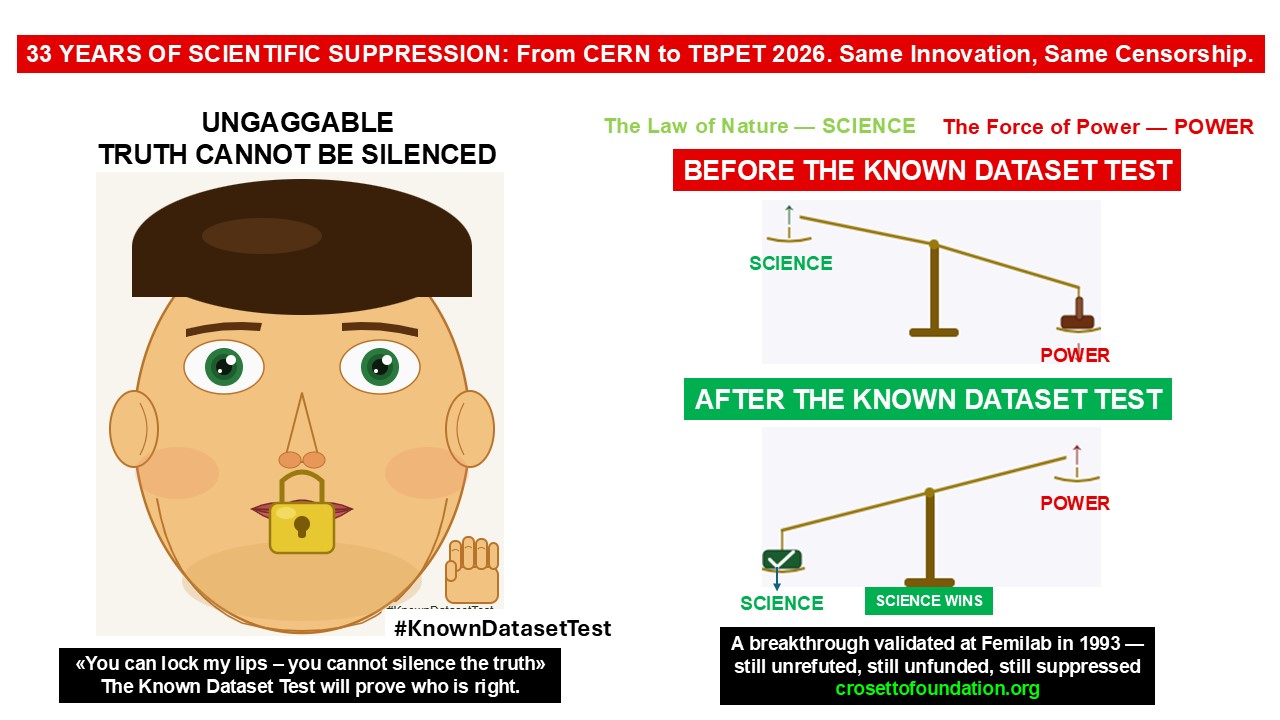
A Media Snippet accompanying this announcement is available by clicking on this link.
Abstract
As a follow-up to the March 20, 2026 press release (https://bit.ly/4ssbvRJ), republished by over 1,000 news outlets reaching a potential audience of 164 million readers, the Crosetto Foundation for the Reduction of Cancer Deaths documents a case of scientific censorship in the open peer-review process of the Total Body PET (TBPET) Conference in Valencia, Spain (May 11–14, 2026) (https://indico.cern.ch/event/1554530/overview).
Italian-American scientist Dario Crosetto submitted a 500-word abstract proposing the ‘Known Dataset Test’ — a seconds-long laboratory experiment to objectively compare the 3D-Flow architecture, recognized as a breakthrough at Fermilab 33 years ago (https://bit.ly/41i4ace) and never scientifically refuted, against current CERN and PET imaging systems.
Reviewers rejected the abstract (https://bit.ly/4lH1zBt), demanding removal of four sentences they labeled violations of ‘ethical rules’ — without ever citing which rules. The four sentences state:
(1) that current PET protocols have failed to improve two-year survival rates in 100,000 patients, citing independent peer-reviewed research;
(2) that scientific progress requires objective verification;
(3) that institutional silence in the absence of written refutation constitutes a breach of duty;
(4) that ideas must be countered with evidence, not exclusion.
Reviewers also censored ‘comparisons with other people's work’ — a standard requirement of scientific peer review — and declared it ‘unethical’ for an author to disseminate his own submitted abstract (https://bit.ly/4lH1zBt). In 33 years, no scientist has ever refuted Crosetto's calculations with counter-evidence.
They have only censored, excluded, or ignored them.
On April 21, Crosetto escalated the matter to the UPV Research Ethics Committee. After two weeks, the Committee has not identified any rule Crosetto violated, has not acknowledged the reviewers' own ethical contradictions, and announced its decision will arrive on May 8 — three days before the conference — leaving no time for meaningful reply.
The Ethics Committee has failed its primary mission by not acknowledging the contradiction and rule-breaking of the TBPET reviewers. ‘Integrity requires courage, not the silence of convenience,’ said Crosetto.
The suppression of the 3D-Flow architecture has caused millions of premature deaths that could have been prevented, and has already cost taxpayers who fund CERN over $4 billion in wasted resources — with an additional $12 billion calculated to be wasted in the next decade unless the Known Dataset Test is imposed on CERN's 650 kW FPGA Level-1 Trigger system (https://cds.cern.ch/record/2759072/files/CMS-TDR-022.pdf) and compared with Crosetto's fully documented 6 kW 3D-Flow system.
To demonstrate the sincerity of his intent, Crosetto offers CERN a free and permanent patent license (https://bit.ly/4cm3NDm) in exchange solely for a public, transparent meeting. He further offers transfer of full patent ownership to the Italian State or the European Union, with a single clause: that a portion of proceeds support new inventions and cancer screening for people with fewer financial means.
The UPV Ethics Committee faces an inescapable dilemma: suppress a 33-year recognized breakthrough, or acknowledge the reviewers' ethical violations and remit the final judgment to the Known Dataset Test — the only objective instrument capable of determining who is right, saving millions of lives and billions of euros in wasted public funds.
Regardless of the Committee's decision, the open peer review will continue. Scientific truth is not determined by institutional authority. It is determined by experiment.
Full documentation of the ongoing public scientific review: https://bit.ly/3P6ILji
Summary of the emails and documents exchanged during the public peer-review process
1. Background: A Press Release Reaching a Potential Audience of 164 Million
On March 20, 2026, the Crosetto Foundation issued a press release (https://bit.ly/4ssbvRJ) republished by over 1,000 online news outlets with a potential readership of 164 million, in which Italian-American scientist Dario Crosetto challenged CERN and industry to a public ‘Known Dataset Test’ to demonstrate the superiority of the 3D-Flow system — a breakthrough recognized 33 years ago at Fermilab (https://bit.ly/41i4ace) — in both high-energy physics and early cancer detection.
Crosetto had submitted a 500-word abstract (https://bit.ly/4lH1zBt) and a two-page summary (https://bit.ly/4cYhUzv) to the Total Body PET (TBPET) Conference in Valencia (May 11–14, 2026), organized by the I3M Institute of the Universitat Politècnica de València (UPV).
2. March 26, 2026: Launched a Public Peer-Review. Reviewers Demand Censorship — Without Citing Any Rule
Since the launch of the Open Peer-Review process on 26 March 2026, scientist Dario Crosetto has documented systemic attempts by reviewers to suppress comparative technical data. On March 26, Prof. Paul Lecoq (CERN Honorary Member) and Prof. Antonio González (I3M-UPV) wrote to Crosetto requesting that he modify his abstract, specifically its final four sentences, which they labeled contrary to ‘the ethical rules we would like to maintain in our community.’ The four sentences in question state that:
- current PET protocols have failed to improve two-year survival rates among 100,000 patients — a citation of an independent peer-reviewed study (Healy et al., JNCI, 2016);
- scientific progress requires objective verification of ideas — a foundational principle of the scientific method;
- institutional silence in the absence of written scientific refutation constitutes a breach of duty toward public health;
- ideas must be countered with scientific evidence, not exclusion.
The reviewers never cited which specific ethical rule had been violated. Not in their March 26 email, not in the April 9 rejection letter, and not in response to Crosetto's repeated formal requests for clarification. Demanding the removal of peer-reviewed data and foundational principles of the scientific method, without providing any scientific or normative justification, is itself a violation of the ethical rules governing peer review.
3. April 6, 2026: Crosetto's Response — Facts, Calculations, Evidence
On April 6, Crosetto responded with a detailed letter demonstrating, point by point, the scientific validity of every statement in question, citing figures, references, and peer-reviewed articles. He reminded the reviewers that Einstein and Lord Kelvin accepted revising their positions when confronted with stronger evidence — and that science demands the same openness from everyone, including reviewers.
Crosetto also reminded Prof. Lecoq that at the 2017 IEEE-NSS-MIC-RTSD Conference in Atlanta, Lecoq himself had approached Crosetto to acknowledge that the scientific PET community had recognized he was right in moving toward PET with a long field of view. If Lecoq acknowledged then that Crosetto had been right, why today censor his claims rather than refute them scientifically?
Crosetto also clarified a crucial point: what the reviewers called ‘unauthorized publication of correspondence’ was in fact the dissemination of the automatic submission acknowledgment from the conference website (https://bit.ly/4sqqBGA) — a fully lawful act for any author. No private email had been made public without prior notice.
4. April 9, 2026: Rejection — With a New Unfounded Accusation
The reviewers rejected the abstract, adding that they were ‘shocked’ that Crosetto had shared his abstract and the correspondence with the media, calling it a ‘violation of basic ethical principles.’ This accusation has no scientific or legal basis: no author can be prevented from disseminating their own submitted ideas or the automatic acknowledgment of their submission.
The reviewers also explicitly censored ‘comparisons with other people's work’ — a demand that directly contradicts the fundamental norms of scientific peer review. Without comparison with alternative solutions, it is impossible to assess the value of an innovation, avoid duplication, or prevent plagiarism.
To draw a direct parallel: when Crosetto reviewed the article on the WPET project (https://bit.ly/4eG0mIX) — a 350 kg wearable garment funded with European public money — he did not simply state that a 350 kg garment was absurd. He provided calculations, references, and scientific evidence refuting every technical claim made by the authors. That is peer review. What the TBPET reviewers did to Crosetto — censoring without refuting — is the opposite. In 33 years, no scientist has ever refuted Crosetto's calculations with counter-evidence. They have only censored, excluded or ignored them.
5. April 21, 2026: Escalation to the UPV Research Ethics Committee
Having received no scientific response from the reviewers, Crosetto formally submitted the case to the Research Ethics Committee of the Universitat Politècnica de València (UPV), to the Rector, and to the Presidency of the CSIC, requesting that a qualified expert reviewer assess the abstract applying the same scientific standards Crosetto had applied in his own review of the WPET — that is, countering every number or statement with which they disagreed with alternative figures supported by calculations, references, and scientific evidence.
6. April 29 – May 6, 2026: The Ethics Committee Does Not Address the Substance
On April 29, the Ethics Committee Secretariat communicated that the Committee had an extraordinary session and he would receive a response next day. The following day — April 30 — no resolution arrived, only the notification that explanations had been requested.
On May 6, the Secretariat communicated that an extraordinary meeting would be held on May 7 and that the final decision would be announced on Friday, May 8 — with no working days before the Monday, May 11 conference. This leaves Crosetto zero meaningful time to respond to the decision, submit additional documentation, or appeal to higher authorities before the conference takes place.
The Ethics Committee, to this day, has not cited any ethical rule that Crosetto allegedly violated and has not acknowledged the contradiction inherent in the reviewers' conduct, who invoked ‘ethical rules’ without ever identifying them.
7. The Core Question: Who Violated the Ethical Rules?
Crosetto did not violate any ethical rule. He presented peer-reviewed data, verifiable calculations, and proposed an objective experiment — the ‘Known Dataset Test’ — as a method to resolve any disagreement. He made public only his own submission and its automatic acknowledgment receipt.
It is instead the reviewers who violated the ethical rules:
- censored fundamental scientific statements without refuting them;
- invoked ‘ethical rules’ without ever identifying them;
- prohibited comparison with other people's work — a standard and necessary practice in scientific peer review;
- conditioned acceptance of one abstract on the submission of a second abstract to a different conference;
- declared it ‘shocking’ and ‘unethical’ for an author to disseminate his own scientific ideas.
The UPV Research Ethics Committee received complete documentation. It has had over two weeks to examine the case. It has yet to indicate which rule Crosetto allegedly violated. It will communicate its decision the day before the conference renders any corrective intervention practically meaningless.
8. The Dilemma the UPV Ethics Committee Cannot Escape
The Committee now faces a choice that will define its institutional credibility:
Path 1 — Suppress: Side with the reviewers, uphold the rejection, and become complicit in the suppression of a 33-year recognized breakthrough that has never been scientifically refuted — at the cost of millions of lives and billions of euros in wasted public funds.
Path 2 — Acknowledge: Recognize that the reviewers violated the ethical rules they invoked, allow the open peer review to continue, and remit the final judgment to the Known Dataset Test — the only objective, verifiable, seconds-long experiment that can determine who is right.
Regardless of the Committee's decision on May 8, the open peer review will continue. Scientific truth is not determined by institutional authority. It is determined by experiment. The Known Dataset Test — inserting 1,000 known dataset-objects into 2 terabytes of data and measuring which system identifies them when sent to the speed of 8 billion events (objects) per second — remains open, documented, and unanswered.
9. The Cost of Censorship
As demonstrated in Crosetto's 400-page patent pending 19/646,511 (https://bit.ly/4cm3NDm), the suppression of the 3D-Flow architecture — when applied to the 3D-CBS (3-D Complete Body Screening) medical imaging system — has caused, and continues to cause, millions of premature deaths that could have been prevented.
When applied to High Energy Physics experiments, the same suppression has already cost taxpayers who fund CERN over $4 billion in wasted resources over the past decades, and is calculated to waste an additional $12 billion in the next decade — unless the Known Dataset Test is imposed on CERN's FPGA-based Level-1 Trigger system (650 kW) and its results compared with those of Crosetto's 3D-Flow system (6 kW), which is fully documented and supported by 59 industry quotes, and must be funded to perform the same test.
10. A Proposal in the Interest of Science and Humanity
The sincerity of Crosetto’s intent — aimed not at damaging CERN, but at strengthening its work and protecting it from billion-dollar waste — is confirmed by a concrete offer: the granting to CERN of a free and permanent license to his 400-page patent pending (https://bit.ly/4cm3NDm), in exchange solely for the organization of a public and transparent meeting to allow the scientific truth to emerge.
Looking further ahead, he also offers the transfer of ownership of the patent to the Italian State and to the European Union, leaving the final decision to the joint evaluation of both institutions, while expressing his strong preference for Italy to assume ownership.
The offer includes a single clause: that a portion of the proceeds be allocated, for the duration of his life, to the funding of new inventions and to the support of cancer screening for people with fewer financial means.
11. The Invention
Crosetto invented the 3D-Flow processor and system architecture in 1992; it was officially recognized at Fermilab in 1993 (https://bit.ly/41i4ace). It is a parallel, programmable, technology-independent digital processing system designed to perform complex real-time pattern recognition for a time longer than the interval between two consecutive input datasets, operating at ultra-high speed.
The distinctive capability of the 3D-Flow invention lies in identifying objects — for example, from emitted radiation, whether particles in high-energy physics experiments or tumor markers in PET diagnostic imaging equipment — arriving at the detector at a rate exceeding 8 billion objects per second, by executing programmable algorithms comprising thousands of operations (addition, subtraction, etc.) on each data packet arriving every 25 nanoseconds, without any loss of incoming data.
12. A Call for Open Scientific Dialogue
‘Scientific peer review cannot become a mechanism by which reviewers suppress comparisons they cannot refute,’ said Dario Crosetto, President of the Crosetto Foundation. ‘Einstein's colleagues were not 'complaining' when they challenged his cosmological constant. They presented facts, calculations, and scientific arguments. That is exactly what Crosetto has done regarding PET, WPET, EXPLORER, CERN FPGA systems, 3D-Flow, and 3D-CBS.’
The Foundation calls on TBPET, UPV, I3M, CSIC, CERN, public officials, journalists, and the scientific community to support an open, documented review in which every disputed claim is answered with alternative calculations and evidence — not with silence or exclusion.
The central question remains unchanged: if Crosetto's claims are wrong, they should be publicly refuted; if they are correct, the Known Dataset Test must be funded immediately.
Dario Crosetto concludes: ‘The Ethics Committee has failed its primary mission by failing to acknowledge the contradiction and rule-breaking of the TBPET reviewers. Integrity requires courage — not the silence of convenience.’
Complete documentation of the open public peer-review (https://bit.ly/3P6ILji). TBPET abstract (https://bit.ly/4lH1zBt) and summary: https://bit.ly/4cYhUzv. March 20, 2026 press release: https://bit.ly/4ssbvRJ, 400-page patent: https://bit.ly/4cm3NDm. For information: info@crosettofoundation.org Crosetto Foundation: https://crosettofoundation.org
CALL TO ACTION
The 3D-CBS (3-D Complete Body Screening) is an advanced PET (Positron Emission Tomography) system whose operating principle is based on the cost-effective filtering of tumor-marker signals from radiation. This is conceptually similar to the essential task performed at CERN, where systems must filter ‘good events’ from large amounts of radiation background.
By improving the detection of relevant signals while filtering noise, this approach offers the potential to detect tumors at a very early stage — with fewer than 100 cancer cells — using very low radiation doses and at low cost. These advantages depend on a breakthrough innovation in identifying and processing meaningful signals within large radiation data streams.
For this reason, it is necessary to organize a panel of multidisciplinary experts for an international public comparative scientific review, similar to the one held at Fermilab in 1993 (https://bit.ly/41i4ace) on Crosetto’s 3D-Flow invention.
Because signal detection, extraction, and analysis are central to PET imaging — and also fundamental to the research conducted at CERN, which is funded primarily by European, U.S., and international taxpayers — it is important that citizens ask their representatives to request that CERN appoint qualified experts to participate in such a review panel and ensure accountability for public funds invested in these research areas.
For these reasons, citizens in both the United States and Europe are encouraged to write to their elected representatives requesting a public comparative scientific evaluation.
Institutional Obligation and Final Call
Parliamentarians and public administrators entrusted with taxpayer resources are not required to resolve technical disputes. They are, however, obligated to demand transparency, public procedures, and measurable accountability. Closed-door evaluations, anonymous rejections, and the absence of public technical comparisons are incompatible with democratic governance when scientific, medical and economic stakes are significant.
The only legitimate path forward is the organization of public, comparative scientific reviews—in both particle physics and medical imaging—where competing technologies can be evaluated openly using quantified metrics, and where conclusions are fully documented and publicly disclosed.
This is not a conflict between individuals or institutions. It is a test of whether science serves truth, humanity, and the public interest.
History will judge this moment not by intentions, but by actions taken when the evidence was already available.
How You Can Help
1. Spread the Word
- Share this information with your personal and professional networks.
- Forward this to scientists, journalists, policymakers, and advocacy groups.
- Use social media to demand a public, evidence-based comparison of current institutional technologies versus Crosetto’s 3D-Fow and 3D-CBS.
2. Write to Your Representative: Demand transparency and public comparative review of these life- and money-saving innovations.
In the United States:
-
Find and contact your U.S. Representative here: https://www.house.gov/representatives/find-your-representative
In Europe:
- Contact your national parliamentarians: Find their addresses at this link.
- Contact your EU representatives: View the full list of all 720 Members of the European Parliament (MEPs) is available at this link.
3. A template letter addressed ‘To Whom It May Concern’ is available for download here.
Contact:
Jennifer Colburn
Crosetto Foundation for the Reduction of Cancer Deaths
DeSoto, Texas
jcolburn@crosettofoundation.org
https://crosettofoundation.org/
Blog: https://crosettofoundation.org/blog/
Facebook: https://www.facebook.com/profile.php?id=100064846172129
Instagram: https://www.instagram.com/dariocrosetto/
Linkedin: https://www.linkedin.com/in/dario-crosetto-4b69a1227/
X: https://x.com/crosettodario
About the Crosetto Foundation: The Crosetto Foundation for the Reduction of Cancer Deaths is a nonprofit organization dedicated to advancing scientific transparency and implementing ultra-high-speed data processing technology to detect cancer at its earliest, most treatable stages. For more information, visit crosettofoundation.org
Biography of the Italian-American scientist Dario Crosetto is available at: https://bit.ly/4tUAFcE.
A more detailed work can be through the links in the left column of the poster: https://bit.ly/4qtDX5n.
APPENDIXES
Callouts:
- "Peer-Review Under Fire: reviewers officially forbid authors from comparing technologies, violating fundamental scientific transparency rules”
- “The 4 sentences rejected by reviewers are not opinion or advocacy — they are supported by facts and data. Censoring facts is suppression”
- “UPV Ethics Committee had 2 weeks to name one rule Crosetto violated. It cannot. Yet it upholds the rejection. That is not ethics — it is suppression."
- "Crosetto’s abstract rejected without refuting calculations, references, or proposed Known Dataset Test"
- "When Crosetto reviewed WPET, he provided calculations refuting every claim. TBPET reviewers rejected his abstract without refuting a single number."
- "In 33 years no scientist has refuted Crosetto's calculations with counter-evidence. They have only censored, excluded and ignored them."
- "Path 1: suppress a 33-year recognized breakthrough. Path 2: acknowledge reviewers' violations and let the Known Dataset Test decide. Choose"
- "Regardless of the UPV decision on May 8, the open peer review continues. Scientific truth is determined by experiment — not institutional authority."
- "The $12 Billion Challenge: Crosetto’s ‘Known Dataset Test’ remains the only objective way to prove which technology is ‘blind’ to cancer signals"
- "Einstein's colleagues provided counter-calculations — they did not exclude him. 33 years of exclusion without refutation is a breach of scientific duty."
Scientific/Technical demonstration of the advantages and benefits of Crosetto’s 3D-Flow breakthrough invention: (https://bit.ly/4aX5R4b).
Summary of Press Releases with Reach and Media Outlets:
- Lang.: Language (EN = English, FR = French, DE = German, IT = Italian)
- MEPs: Members of the European Parliament
- Sci.: Scientists, IEEE, CERN, Leaders
- Pub.: General Public, Media, Journalists (Total Potential Reach: M = million, K = thousand)
- To: Recipients (Total Potential Reach / Known Unique Readers) + unknown readers
- Media: Number of media outlets publishing (see thousands of links at https://bit.ly/3HtisQv).
| Date | Lang. | Link | To | Media |
| 03/20/2026 | EN | https://bit.ly/4ssbvRJ | PUB (164M/60k) | 1.000 |
| 02/15/2026 | EN | https://bit.ly/4sfxR97 | Pub (150/21k) | 946 |
| 12/20/2025 | EN | https://bit.ly/4aX5R4b | Tech/Sci. Dem. Pub (150M/22k) | 1,000 |
| 11/07/2025 | EN | https://bit.ly/43idsFY | 300 | |
| 10/28/2025 | EN | https://bit.ly/4qKVar8 | Pub (148M/13.8K) | 940 |
| 09/15/2025 | EN | https://bit.ly/41TMUKF | Cancer Pub (145M/11K) | 804 |
| 09/06/2025 | EN | https://bit.ly/3HYBePY | Pub (145M/23K) | 876 |
| 08/28/2025 | EN | https://bit.ly/4p0DneC | Tech/Sci. Dem. Pub (116M/22K), MEPs (720/420), Sci (40/27) | 597 |
| 07/15/2025 | EN | https://bit.ly/4m57FKZ | Pub (87M/10K), MEPs (720/41), Sci (40/14) | N/A |
| 07/04/2025 | FR | https://bit.ly/4lfjnTe | Pub (8.3M/2.5K) | 421 |
| 07/04/2005 | DE | https://bit.ly/3TTV0yb | Pub (11.3M/2.4K) | 487 |
| 07/04/2025 | IT | https://bit.ly/4loi7go | N/A | <5 |
| 07/03/2025 | EN | https://bit.ly/44cIbVQ | Pub (63.7M/2K), MEPs (720/448) | 441 |
| 06/30/2025 | EN | https://bit.ly/3TMnDNI | N/A | N/A |
| 06/30/2025 | IT | https://bit.ly/4nsvk9E | N/A | <5 |
| 06/23/2025 | EN | https://bit.ly/4era28b | MEPs (720/423) | N/A |
| 06/23/2025 | IT | https://bit.ly/3T7G1R8 | N/A | <5 |
| 04/14/2025 | EN | https://bit.ly/4oNUOyT | Technical Scientific Demonstration to Scientists |


Legal Disclaimer:
EIN Presswire provides this news content "as is" without warranty of any kind. We do not accept any responsibility or liability for the accuracy, content, images, videos, licenses, completeness, legality, or reliability of the information contained in this article. If you have any complaints or copyright issues related to this article, kindly contact the author above.
